My WHY and HOW for Blogging

WHY?

The Road-map for Humanity is Recalculating

Technology placed in the hands of as many people as possible, who are linked to each other and their creations, is birthing a type of human interaction across business, art, education, and society that is still morphing into what-we-can-only-guess. I will contribute to the road-map recalculation.

HOW?

I am a Thing of the Internet (ToI)

This blog is my personal center on the web, where I can feel any thread and sense a vibration from the other side of the world, or pluck my own thread and see who resonates with my vibration.

Leaving Misahuallí Part II – Mountain God Sacrifice

We thought we had left our troubles in the jungle behind us. So far, we had avoided getting stuck in the mud like the Germans, and we had successfully patched together wiring for the engine with gum and a foil wrapper. We were well into the day and had left the low Oriente and were ascending the mountains on the way back to Quito. If you don’t know, Quito is at 10,000 feet.

I have no idea where we were, but at some point we hit… a traffic jam. Yes, a traffic jam in the mountains. Apparently, this road was also used by everyone returning from a weekend on the coast back to Quito, or field-hands returning from cutting bananas and pineapples or going to points in-between and beyond. At first, it was just an annoying slog of stop-and-go driving. But eventually, our forward progress stopped almost completely. We made it to one turn which enabled us to see the traffic both behind and in front of us. All along the zigzags, cutbacks, and hairpin turns we could see an endless line of cars. We had no idea what had happened.

The late afternoon turned into dusk. We could see people getting out of their cars to answer the call of nature, or in some cases to vomit from a combination of stress, fatigue, and altitude sickness. I could hear babies crying and people shouting. Then, dusk turned into night. We had made little progress in hours. As I mentioned in Part I of this adventure, we were driving Jeeps, and our drivers were very skilled and aggressive drivers, which is necessary in Quito where rockfall is as common as rain. This is where the capabilities of the Jeeps and our drivers put us in danger by getting us way to close to the problem!

Antonio became very impatient. There was no way to pass on the narrow mountain road. Well, there shouldn’t have been a way to pass. The upward mountain side next to the car wasn’t a 90-degree cliff, it was sloped, maybe 30 to 40 degrees. Antionio kept two tires on the road and the other two on the side of the mountain. We drove, tilted to the side in this way, in the dark, until we reached the front. It was terrifying. I kept thinking we were going to flip over. But Cousin Antionio, and the driver of the other Jeep behind us, managed to get us to the front. But this turned out to be the worst place to be, for us. You see, an American oil company, Chevron maybe, was moving a drilling rig, and it was stuck on a hairpin turn. I had never seen a truck this long before. It was a flatbed truck but so long that it had an oil rig, or part of one, strapped down laying on its side. I couldn’t even count the wheels of this monster, but I believe it was something like 14 wheels! So, why was this a worse position for us?

First, we had a front row seat to the truck team trying to inch forward and backward to get around the turn. It was breathtakingly suspenseful. The truck could barely move in any direction, and it had to go to the edge of the cliff every time it made a move. The truck was able to turn not by degrees, but by fractions of a degree with each maneuver. My heart was in my stomach, and my stomach was trying to flee my body. In the middle of all of this, the Ecuadorians had become very upset.

A mass of men had assembled and marched to the front where we were, carrying flashlights and lanterns; they were also waving over their heads the machetes they used to harvest bananas and pineapples. All of them were shouting, “GRINGOS VAYANSE A CASA!” – gringos go home!, and sometimes just, “GRINGOS, GRINGOS, GRINGOS”.

We were thankful that it was dark but still we were in the front of the line of cars and potentially very visible. Being as light-skinned as we were, it would have been easy to pick us out for gringos had the mob not been focused on the truckers. We were riding in the back of the Jeep which made it easy to get below the window and cover ourselves with whatever we could find. Nobody felt like being sacrificed to the mountain / volcano gods of Ecuador. Now we could only hear as the big rig repeatedly shifted gears and ground its tires into the dirt and rock as the driver spun the wheel right, then left, then back again, over and over. Finally, a cheer erupted as the truck squeezed around the curve, and then there was the sound of dozens of boots on the hard scrabble racing back to their cars and trucks.

After many more hours, under a thankfully moonlight ride, we reached home to the neighborhood of San Rafeal, in Quito. There was one more small thrill on the way home. We passed warning signs to stay clear of dynamite blasting areas, which was very spooky to see on our now empty road!

That’s all for our adventures leaving Misahualli, but there are more stories to tell of our time in the jungle, other parts of Ecuador, and the Galapagos Islands!

QR Code Series: The Walking Dead, Atomic Paw, Feature Zombies and “Look at the Flowers”

— QR Code Series1

Short Description: This t-shirt has the “Atomic Paw” logo and several signatures. The pictures in the panel above the t-shirt are of the actors signing the t-shirt at one of the Miami SuperCons.

The Walking Dead / Atomic Paw T-Shirt

The logo is from Invincible, another Robert Kirkman comic. I couldn’t find this t-shirt to buy at the time, so I made it myself — copy and paste the logo from the Internet and printed it onto transfer paper to make the t-shirt. Connection to the Walking Dead comic:

  • The shirt is worn by Carl Grimes, Rick’s son, in several episodes throughout the series.
  • Based on a comic hero: The symbol on the shirt is not from The Walking Dead. It is the logo for “Science Dog,” a fictional comic book hero created by Robert Kirkman, who also wrote the comic book series that inspired The Walking Dead. Science Dog appears in Kirkman’s other comic series, Invincible.
  • Symbolic meaning: Within the context of the show, the shirt serves as a reminder of Carl’s pre-apocalypse life, when he likely enjoyed reading comic books.

Feature Zombies / “Look at the Flowers”

There are several signatures of “Featured Zombies” (actors who portray recuring or noteworthy zombies) on the shirt. Each signing was photographed and can be seen in the photos on the panel above.

One signature is not from a zombie character but is from the actor Kyla Kenedy. While not a zombie, her character had it’s own “zombie adjacent” story:

About Kyla Kenedy and the Role of Mika

  • Her Character: Mika Samuels was characterized as a caring and mature child, a stark contrast to her older sister, Lizzie.
  • Her Death: Mika’s death at the hands of her own sister, Lizzie, in “The Grove” is a pivotal and shocking moment in the series, highlighting the psychological dangers of the apocalypse.
  • Kyla Kenedy’s Experience: Kyla Kenedy has expressed that she found Mika’s death impactful and was grateful for the way her character’s story concluded on the show.
  • Acting Career: After The Walking Dead, Kenedy went on to play other notable roles, including Izzie on the film Raising Izzie and Dylan DiMeo on the ABC sitcom Speechless.

After Lizzie kills Mika, Carol asks Lizzie to come outside to gather some flowers for Mika. Lizzie realizes Carol is upset and thinks it is because she’d pointed a gun at her. Lizzie starts crying and saying she was sorry but Carol, now crying also, insists she look at the flowers. She draws a revolver and shoots Lizzie in the back of the head, and buries the sisters’ bodies.

  1. Posts can be directly accessed from the QR Code placed on the respective photo, collectible, or other memorabilia in our personal collection. ↩︎

QR Code Series: The “Original” Miami Miracle & O.J. McDuffie #81

— QR Code Series1

Who is O.J. McDuffie #81?

The Miami Dolphins cap you are looking at was signed by O.J. McDuffie in 2007 at a Dolphins’ home game and given to Ryan. Quick Facts (Click this link for more info on O.J. McDuffie):

  • He played for Miami from 1993 to 2000
  • McDuffie became known as Dan Marino’s favorite receiver. His 415 career catches are fourth all-time in Dolphins history.
  • In 1998, McDuffie caught 90 passes, leading the NFL in that category. He was the first Dolphin to achieve this mark (since achieved by Jarvis Landry in 2017).
  • That same year, McDuffie became the first player in NFL history to record at least 90 receptions and 10 punt returns in a season without a fumble. Antonio Brown of Pittsburgh in 2016 is the only player to do it since.
  • With the exception of Mark Clayton and Mark Duper, McDuffie caught more passes thrown by Marino than any other Dolphin receiver.

How Did We Get His Autograph?

There is much to say about the home game where we got his autograph in the last section. We were seated in the end-zone, and O.J. McDuffie was only a few rows and seats away. We saw many people going up to him for autographs and he was signing and taking pictures with everyone. I don’t remember which quarter it was, but eventually Ryan and I went over to him and asked him to sign the Dolphins cap. He was very nice and Ryan was excited to get his autograph.

After 13 games the Dolphins had a perfect record… of LOSING!! They were about to be historical for having the only perfect winning season (hooray ’72 Dolphins… who were all in attendance for a special recogniztion ceremony, oh — the humanity!!!) and were about to be only the fourth team (at that time) of having a perfect winless season. At the end of the half the Dolphins were once again losing. Cue the tears.

But then…

  • Dolphins’ comeback: Miami’s offense, led by quarterback Cleo Lemon, mounted a comeback. Running back Samkon Gado scored on a 7-yard run to cut the lead to 13–10 in the third quarter. A field goal from Jay Feely later tied the game at 13.
  • 4th Quarter drama: The teams traded field goals to force overtime!
  • Overtime drama:  The Ravens got the ball first. Their drive ended when kicker Matt Stover missed a potential game-winning 44-yard field goal.
  • Overtime win: On the Dolphins next possession, Cleo Lemon hit wide receiver Greg Camarillo with a short pass over the middle. Camarillo broke away from the defense and raced 64 yards for the game-winning touchdown, sealing the victory for Miami. 

It is hard to describe the reaction in the stands that day. WE ALL WENT NUTS!! Everyone was screaming, jumping, and hugging each other. People were crying, throwing anything they could find into the air, and pounding on the seats. The crowd, including us, was more emotional than if we had won the Super Bowl. I am not kidding. We had not won a single game, and we had little hope of winning the next two games (and we did not), so this game against the Ravens was our only hope to avoid a winless season. The energy had been built-up to an unimaginable level as the leads kept changing in the second half and we escaped game-ending close calls in the fourth quarter and in overtime.

Here is a short video with the highlights and analyst excitement!

  1. Posts can be directly accessed from the QR Code placed on the respective photo, collectible, or other memorabilia in our personal collection.  ↩︎

QR Code Series: Mark Wahlberg Chance Meeting

— QR Code Series1

In 2010 mother, Elaine, took my son, Ryan, and his friend Hillel, to the Aventure Mall, in northeast Miami-Dade county. If you’re not familiar with that mall, it’s one of the biggest in the US. They ate lunch at Johnny Rockets across from the movies. When they were leavin they spotted Mark Whalberg.

My mom always carries an “instamatic” camera, and they asked Mark for a photograph. He was very kind and posed with his arm around Ryan and Hillel. The picture cane out blurry but you can tell it is Mark.

My mom thanked him and said, “I love you in Blue Bloods”, which is one of her favorite TV shows. Mark said, “That’s my brother Donnie, not me.” He was a good sport about it!!

  1. Posts can be directly accessed from the QR Code placed on the respective photo, collectible, or other memorabilia in our personal collection. ↩︎

Leaving Misahuallí Part I – Mud and MacGyver

What is Misahuallí? Where is Misahuallí? Why were we leaving it?

Oh. And how to pronounce Misahuallí? It’s pronounced miss-ah-wah-YEE.

This story starts in medias res, or “in the middle” for non-speakers of dead languages. We had spent four days on the Napo river in the Ecuadorian Amazon jungle, the Oriente. This was only one part of our adventure vacation, where within one country we would straddle the equator, hike a volcanic mountain to touch snow, go boating on a lake in a volcanic caldera over 10,000 feet in altitude, explore the Amazon, and be humbled by nature in the Galapagos Islands (still technically Ecuador!).

..and also where we would have a couple of near-death experiences. Sort of.

With me was my fiancée, a.k.a. future ex-wife as this adventure was in the early ’80s. Also with us most of the time were another dozen classmates of hers from university, and another half-dozen local family of one of the classmates. We were a big hungry caravan most of the time, which given the currency exchange rate did not cost much at all to feed.

Anyway, I’m starting this story from when it was time to leave the Amazon. Misahuallí is a common and convenient point-of-departure (and return) for canoe’s launching on the Napo river and going deep into the jungle. I don’t know what the town is like today, 40 years later, but back then it was a cliché out of every Hollywood film. You know the look, where the outpost town is scary as shi… can be. Our parking area was a mud-pit. The main street was dirt. A dead dog with buzzing flies lay in the middle of one street. The town drunk (or murderer of tourists???) hung both his arms out of his jail cell overlooking what I assumed was the main intersection.

I’ve only seen Misahuallí referenced once in literature, in a short fiction story by Malcolm Bosse. Here’s how he described Misahuallí.


…then hired a chauffeured car and headed for Oriente, a remote area of vast rain forests. When they reached their destination, a dirty river town called Misahuallí, their driver Jose unloaded their bags in front of a cement-block building with hotel in faded blue primed over its doorless entrance. He offered to arrange for a guide and supplies,

“No,” said Sheldon, “that’s my job,”

“Be careful,” warned Jose. “Many of these people are thieves and worse.”

“What do you mean, worse?”


So, yeah, that was the vibe in Misahuallí.

Only the hardiest of our entourage had gone into the jungle, so we were using just two Jeeps. Leaving Misahuallí at the same time were a couple of Germans in their Jeep. Fun fact – one out of ten vehicles in Ecuador is a Jeep. I think in Quito it’s one in five. When Pope Francis visited in 2015, yes, he was driven in a Jeep.

You will understand the obsession with Jeeps momentarily.

We were able to drive our Jeeps out of the mud-pit, but the Germans were stuck. Not the Jeep’s fault, they simply didn’t know how to drive like the locals. One of our drivers, cousin Antonino maybe, hooked-up a cable from our Jeep to the sunken Jeep. Then, like in the scene from Jurassic Park II where they are trying to save the mobile lab from going over the cliff, he used five different gears, rocked, spun rubber and spit mud until the German’s were freed.

Hooray.

We didn’t know the toll that the struggle had taken on our own Jeep.

The second Jeep in our caravan had driven ahead while we played tow-truck rescue. By the time we were on the road, they were out of walkie-talkie range. This was pre-1985, so no commercial cell phones were being sold to the average consumer in Latin America, and there were certainly no towers in the jungle, probably still aren’t.

We were tearing down the road at a pretty good clip trying to make up for lost time. The roads in and out of the Oriente are also dirt. Uneven. Stony. Rocky. Bumpy. The Jeep dealt with the conditions as good as could be expected, but we were definitely bounced around a lot. And then it happened. Maybe it was the strain of towing the other Jeep out of the mud. Maybe it was the beating the Jeep had been taking for ten days all over Ecuador. But whatever the cause…

The Jeep went silent. No engine noise. We drifted to a stop.

Everyone got out and the men popped the hood. I was still a teenager (nineteen or barely twenty) so I didn’t really qualify as one of the men. I knew nothing about cars, so I was just a bystander. The gas tank was not empty. The engine temperature was fine. There was no snapping or cracking noise before the engine went dead. They even removed the distributor cap and cleaned it — I actually did know that old trick. There were no fluids leaking out from underneath the Jeep.

The driver turned the engine but the engine wouldn’t turn.

This, to say the least, was not good. We had probably driven 40 or 50 miles. There was no traffic passing by us. The next speck of civilization was even farther down the road ahead of us. By the time the rest of our party reached home and then waited several hours for us not to arrive, it would be dark and too dangerous to come back until the next day.

OK, not that scary you say? Anyone should be able to survive 24 hours stranded on the side of the road. But you try to stay calm when you have no food or water (hey, we were headed back home, provisions were gone), it’s 90 degrees, you’re in a foreign country, and basically still in the jungle.

Finally, someone found the problem. A wire had broken. No electricity could flow to the spark plugs. No spark plugs, no combustion. Now, if the wire had broken on the contact at one end or the other, then that would not have been too hard to fix. Strip the insulating coating over the wire and re-wrap it around the contact. But this break was in the middle of the wire. Hanging in space.

We could strip the wire clumsily with our camping knives. And we could kinda sorta half-braid, half-wrap the bare wires together, but that would not hold. We were still stuck. Then, as if by a supernatural power, a MacGyver happened.

Chewing gum and a foil wrapper. I swear on a stack of On the Origins of Species. Someone was a big gum chewer, and apparently, we had plenty of that left. So, to bridge the gap between the wires, insulate it, and make it hold for the journey ahead, they used wads of chewing gum and foil wrappers.

We got back on our way, it was so unbelievable it was hard not to laugh. The gum solution lasted the whole way home, but there was another almost near-death experience waiting for us in the mountains that stood between us and home.

Read the exciting conclusion coming soon in Leaving Misahuallí Part II, or How not to be Thrown Over a Cliff or be Chopped Up by Machetes.
Nerding Badly: or How We Lost a Unique Cultural Treasure, were Naïve About Stars and their Groupies, but Still had an Amazing Con

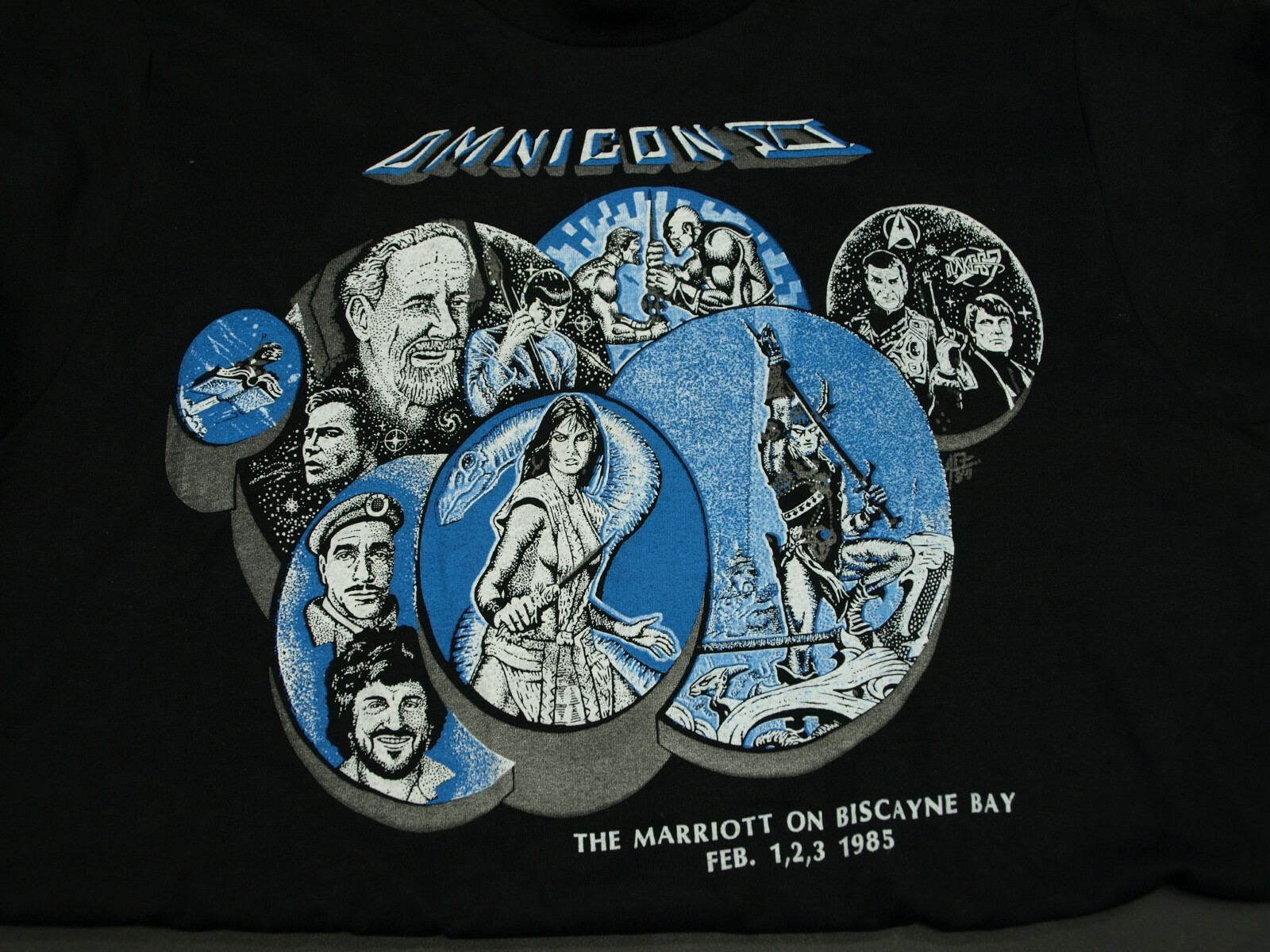
It was early 1985. Long after Star Wars but well before the “Comicon” convention, entertainment and merchandise mega-industry mutated — like a super villain bitten by a radioactive capitalist — into what it is today. I was 20 and an SF and fantasy fan, but not quite a fanboy. Somehow I had managed to get “on the board” of a comic book, Dr. Who and Fantasy/SF convention in Miami, Fl — Omnicon VI. I wasn’t really on the board in the sense of making decisions, but I attended some board meetings and was given a key role. For no reason that I could tell other than no one else wanted the job that required endless hours of prep and time away from the convention floor during the convention, I was put in charge of pre-registration, registration and guest check-in at the door of the convention.

It all began, as all real stories do, with a chance event. A new graphic artist in my family’s business and I had become good friends. After Tiki-Al was hired, we quickly realized that we had a shared obsession of everything science-fiction. I have a few stories about Tiki-Al, but this story is about Omnicon VI in 1985. Tiki-Al was on the board of Omnicon VI, thus my connection to the convention started with them ordering the official convention t-shirts through my family’s business, thanks to Tiki-Al.

[While writing this story I did some googling to check my memory on a few things and found a link to the actual t-shirt on eBay that my company made, that Tiki-Al himself illustrated, but it had been sold. Oh, the humanity!! If anyone knows the owner of this shirt, please contact me! You can even see Tiki-Al’s signature (Al Zequirea) below the “Blakes7” art.]

So, somehow, getting paid to supply t-shirts morphed into me having fun with box after box of pre-registered attendee letters (1985, real mail!!) I had to make a master pre-registration guest list and hundreds of frakin’ badges. FOR FREE. Maybe I was a fanboy after all, who else would do that? That’s right, boys and girls, I had to open hundreds of envelopes by hand, and then hand-write the hundreds of name badges. I would not own my first computer, a Commodore 128 with a dot-matrix printer, until 1986. Timing is everything.

Looking back it was a fantastic guest list for a Con our size. Oh! those innocent days. I don’t have the program or a good-enough memory to list half the guests, but we had amazing guests. We had Tiki-Al of course, but this was before he was famous. We had guests from Dr. Who (Nicholas Cortney, en.wikipedia.org/wiki/Nicholas_Courtney) Blakes7, the incomparable SF Book Cover and Rock Album artist Michael Whalen (https://www.michaelwhelan.com/home/), the SF author and Symphonic Composer Somtow Sucharitkul, (en.wikipedia.org/wiki/S._P._Somtow), so many more, and the guest of honor and cause for our great and lasting shame, Theodore Sturgeon (seriously? google him, I’m not giving you a link), whose Star Trek scripts were the least of his achievements, such is his lasting impact on SF.

Theodore was a confirmed guest, but he was in ill health and had become bed-ridden after a long battle with lung disease. He was unable to endure the flight from the west coast to Miami; he was literally on his death bed. Yet, even though he had to cancel his appearance, he recorded his keynote speech and sent it to us.

His last public thoughts, recorded and spoken by himself.

Sent to us.

AND WE LOST THE CASSETTE.

As I said at the beginning, these were innocent times, and this was a convention on a budget. We didn’t have our own security, or a process to record chain-of-custody for the various artifacts we were entrusted to protect. Someone placed the cassette in a boom-box and set it backstage in preparation to play it for the convention. And walked away. Enter stage right, a sticky-fingered fan scoring a fifteen-dollar tape player. Thus, Theodore Sturgeon’s final grain of sand on his wide beach of works, simply walked away. He passed away 90 days later.

But wait, there’s more. Not as tragic a sub-plot, but what it lacks in gravitas, it makes up for with salaciousness.

One of our top-draw guests (I will be discreet until 50 years after his or her passing) was young and, of course, famous, at least famous in this crowd. Now, we (the convention / board of directors “we”) had rented rooms at the Marriot for our guests. It never occurred to us to do things like, I don’t know, have a babysitter for the single guests, put a cap on room service charges, or print or even think of a code of conduct (#MeToo).

You can see where this is going, right? We got notification of a thousand dollar room service charge (ok, maybe it was less, this was the Biscayne Bay Marriott in ’85, not a South Beach boutique hotel in 2020) for the guest-whose-name-I-will-not-speak. Apparently he or she had one or more young groupies in and out of the room, and much alcohol, adult movies, and food was ordered.

Not only was it a more innocent time but I was more innocent than I should have been at my age. At the very beginning of the convention, this randy guest made a pass at me. I don’t know if I was more shocked or flattered, but it never occurred to me to warn anyone to be on the lookout. For the record, I took a pass — but I do believe room service was thrown in as an incentive!

But even with the cultural tragedy and mini-scandal, it will always be the best convention that I will ever attend. As a “board member” I was seated at the luncheon table with Michael Whalen, mixed with all the stars, saw a lot of cool merch, and met…. EVERY. SINGLE. ATTENDEE.

In charge of registration and check-in? Never again.

Cryptocurrency Is Real Even If You Can’t Buy Groceries With It

Bad Argument (pun intended for programmers)

There are legit reasons to be wary of cryptocurrencies, maybe that will be another post. However, there is a common argument I’ve heard a lot recently that doesn’t match up with reality; “I can’t spend it in my local-fill-in the-blank store.  If you want to stay away from Bitcoin and others, fine.  But you should understand why you are staying away.  That is what I will cover on this soapbox, er… in this post.

First, this message: “Money” is not the only Basis for an Economic System

Let’s Commune

Communes aren’t just for the distant middle-ages and ’60s hippies.  Communes are very much alive and featured in Israel where the name for a commune is Kibbutz. As recently as 2005 there were 120,000 people (2.6% of the Jewish population) living on 268 kibbutzim – the plural of kibbutz.  There are many variations on how to construct the economy of a commune.  Suffice it to say that in addition to using money, or sometimes completely replacing money, the currency for investment is labor, and the store of value is property (anything that is an asset).

Bob the Barterer

Sure, Bob the Builder wants to get paid in cold hard cash, but Bob the Barterer is OK with providing his services in exchange for something else of value that you have.  People, and entire countries, have bartered (aka traded) since prehistoric times and continue to do so today. Motivations to barter range from philosophical, to matters of life and death in a hyper-inflating currency.

The point of the above paragraphs was to soften you up for my rebuttals to the “I can’t spend it” argument.  Money is not one thing, alternatives to money are not evil, money really is a construct, and money is not the only construct that exists for the exchange of goods and service and storing value.

Rebuttal #1: Love me Tender Love me Sweet (Sorry Elvis)

There could not be a worse reason to avoid cryptocurrency than the fact that it is not a legal tender – yet. The argument goes something like this, “I can’t go to my grocery store and use cryptocurrency as legal tender to purchase anything.”  That is true.  But money (what you think of as legal tender) has at least two functions. It serves as a medium for transactions and as a store of value.  There are many financial instruments and mediums of exchange that only fulfill one function or the other.

Medium for Transactions

Is the Euro money? Is the British Pound Sterling currency? Hopefully you said, “yes.”  But in most countries outside of Europe, and certainly in the United States, you cannot buy groceries with Euros.  Does that mean Euros are not real, and should not be part of your investment portfolio?  Of course not.  You may have other reasons for not wanting to have foreign currencies s as part of your nest egg — but the inability to spend it in your grocery store does not factor into it.

Are “food stamp” (SNAP: Supplemental Nutrition Assistance Program) vouchers a form of money?  Well, you can spend them in a grocery store.  And what about coupons and gift cards?  You can by almost anything with them, but they are not money and in most cases neither are redeemable for cash, so they are not a store of value either.

Just because you can’t use something printed on a piece of paper (Euros) at your grocery store doesn’t disqualify it as money.  And just because you can use something printed on a piece of paper (like a coupon or voucher) at your grocery store does not mean it is money.

Rebuttal #2:  Is it Safe?  Is it Safe? (this time a movie reference, “Marathon Man”)

As a Store of Value

Says the concerned investor, “Cryptocurrency can lose value, or be wiped out!”  To which I reply, “That’s right, Virginia, there is no Santa Claus.”  Below is a list of investments, stores of values, that can drop dramatically in value or be wiped out.   How many are you excluding from your investment portfolio?

  • Bonds, incl. government bonds!! (default risk, inflation risk, interest rate risk)
  • Cash  (inflation risk, currency manipulation)
  • Stocks
  • Foreign Currency
  • Commodities / Futures
  • Derivatives in general
  • An insurance policy based on market-tied performance
  • Direct ownership of gold, silver, diamonds (coins, bullion, or jewelry)
  • Real estate
  • Collectibles

So… everything may lose value – even cash and bonds. Your job is to align what you believe to be true about risk versus return, and diversify your portfolio accordingly.

Not an Endorsement of Cryptocurrencies

Only you can decide what to hold in your portfolio, and what percentage of your portfolio it should represent. Your goals, risk aversion, timeline, and ability to recover from financial setback is on you and you alone.  I am not telling everyone, or even anyone, to invest in cryptocurrencies.  But if what is holding you back are the points reviewed in this post, then maybe you should re-evaluate.